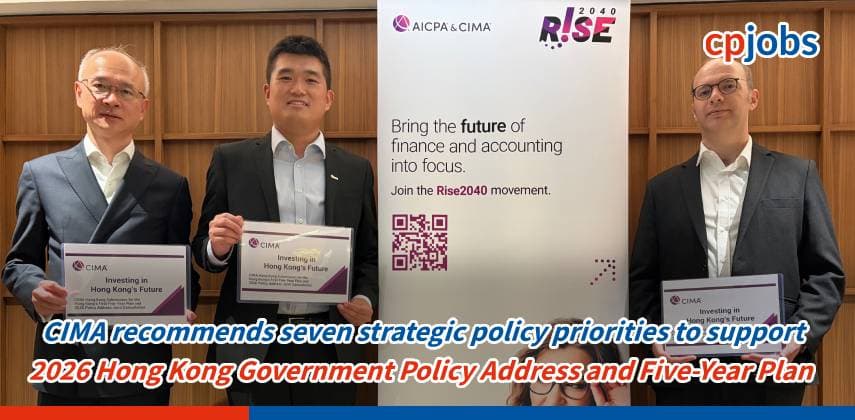
The Chartered Institute of Management Accountants (CIMA), the world’s leading professional body for management accountants and one of the founding member bodies of the Association of International Certified Professional Accountants, has submitted strategic policy recommendations to Mr John KC Lee, GBM, SBS, PDSM, PMSM, Chief Executive of the Government of the Hong Kong Special Administrative Region ahead of his Hong Kong’s first Five-Year Plan and 2026 Policy Address.
Based on a survey of CIMA members and students in Hong Kong, CIMA have recommended seven practical measures to strengthen competitiveness, productivity and livelihoods, while maintaining fiscal discipline and supporting alignment with the National 15th Five-Year Plan.
- Driving competitiveness and sustainable growth by establishing a five-year Competitiveness and Growth Framework with measurable targets, clear accountability and annual progress reporting to strengthen Hong Kong’s position as a leading international financial centre.
- Developing future-ready talent and skills by aligning education, professional qualifications and workforce development initiatives with the needs of an AI-powered economy, with a focus on finance, technology, sustainability and leadership capabilities.
- Deepening and differentiating Hong Kong’s capital markets by expanding offshore RMB capabilities, advancing digital assets and FinTech development, strengthening Greater Bay Area co-operation, and supporting sustainable finance.
- Preserving Hong Kong’s international gateway role by enhancing international connectivity, attracting global businesses and talent, and reinforcing resilience against climate, cyber, economic and geopolitical risks.
- Promoting trusted AI adoption and governance by establishing a clear AI governance and adoption roadmap that supports innovation while ensuring accountability, transparency, security and responsible use across the economy.
- Simplifying regulation and public administration by streamlining regulatory processes, improving digital public services, and strengthening engagement with public and professional bodies to enhance efficiency and competitiveness.
- Expanding workforce participation and social mobility by increasing access to affordable childcare, supporting parents returning to work, promoting lifelong learning and reskilling, and enabling older workers to remain economically active through flexible employment opportunities.
Talking to these recommendations, Andrew Harding, FCMA, CGMA, Chief Executive, The Chartered Institute of Management Accountants, said: “Hong Kong’s first Five-Year Plan presents a unique opportunity to set a clear vision for the city’s future, whilst driving strong delivery and accountability. Through focused investment in talent, AI capabilities, capital-market development and workforce participation, Hong Kong can enhance productivity, strengthen competitiveness and further establish itself as a leading international financial centre in an AI-powered world.”
It is envisaged these recommendations would help deliver three key outcomes:
- Positioning Hong Kong as Asia’s premier international financial centre for an AI-enabled economy by 2030, leveraging its strengths in finance, innovation and professional services.
- Strengthening Hong Kong’s role as the trusted gateway between Mainland China and global markets, enhancing international connectivity, capital-market development and Greater Bay Area co-operation.
- Embedding accountability and delivery at the heart of policymaking through measurable targets, clear ownership and transparent annual progress reporting.