Accidents happened in almost all marathon races. Is marathon dangerous? Not at all if people have sufficient training and do not have inherit disease. A young man who was a sport enthusiast ran his first half marathon years ago. It should not be difficult for him but he dropped out at 12km. This smart guy was too confident that he had not trained for distances close to a half.
Many years ago, I was serving a company handling a scaled project. I had a colleague helping me to discharge my duties. He was that kind of person who was weak in language, good at mathematics and did not hold good qualifications. A company hunted him with salary soaring by 40%. He was high spirited and spent his last month light-heartedly. He intended to improve his English to normal standard in 3 months. 3 months after he left us, he returned office uttering words that we did not understand. He suffered from serious nervous disorder and lost working ability. According to his family, he could not withstand the pressure of his new job.
Some people believe that their will can enable them to achieve something big and take up many “mission impossible”. As life experiences grow, we should be able to discern the extraneous environment around us, understand how things work and our own limits. Some can develop these abilities at early age but some never have this day. Developing this skill needs profound observations as well as analyses together with introspections to reveal our abilities to tackle problems. This then built up data that we can retrieve for handling other similar situations. The earlier we grasp this ability, the better we can perform as the dexterity on handling tasks of various complexity is built up bit by bit. There is no end of the road.
In 2009, a team of Chinese climbers ascended to the summit of the Mt Everest. Among them, there was a climber who was physically sound, had a strong sense of self discipline and strong willed. The deficiency was – he had no mountain experience beyond 6,000m. Mt. Everest, at 8,848m, is a different story no matter how professional was his climbing skill. The man at last reached the summit but fully exhausted and stayed at 8,700m, forever, at his return.
Can will power really help us to achieve greatness? Certainly, it depends on how we use it. I would use this power for preparation work and day to day operations. At the last blow, this power can enable us to perform a little bit better but cannot boost us substantially beyond limit except in the case of a miracle. For example, marathon runners always perform better during race than in training sessions. Both marathon and mountain training consumed me plenty of time. If not of will power and perseverance, waking up before 6:00am and encircling the happy valley race course for 3.5 hours once a week with shorter runs in other days of the week proved to be intolerably painful. Greetings to the elderly, the working class, the retired groups and the gardeners in different time zones seemed to be a routine job. For mountaineering training, reaching the base of a hilly range at 6:00am with a backpack stuffed with 15kg dummies and feet with weight belts was also a routine training. Trekking along the hilly ranges with many ups and downs and returning in 3 hours was surely a demanding exercise. “Can this be sufficient for Everest?” “Who knows!” The other summit climbers could not give a hint too.
Why I still persisted on something that I was not sure? The answer was, it definitely helped though it might not be sufficient. At least, this could push me a few hundred meters up. Of course, building muscle strength was part of the imperatives. Researching for high mountain sickness, testing the body for effectiveness of different types of trainings were all prime tasks. Mental preparedness, another faucet, needs great attention. When people prepare to do a cross country run for 15km, they can hardly increase the distance to 20km. Their minds keep telling them they cannot achieve it this time. However, the same group of runners can run a race of 25km without difficulty when psychologically prepared. It is the same for mountaineering. The difference of 6,000m mountain and 8,000m, apart from acclimatization and muscle strength, is mental preparedness for the hardship that will be encountered. With full awareness, it would not be too hard to overcome our inner problems.
Using our will power wisely can boost us to achieve big. Reliance too much on will power in the last shot may probably kill us, not only in mountain but also in our career. The crucial point is: can we withstand the hardship, loneliness and the stress during day to day trainings and works? Some people are self-motivating and can easily build up interests on all the domains they encounter in their life journeys. If you are not, try every effort to be that kind of people. This can give you tremendous help on achieving targets.
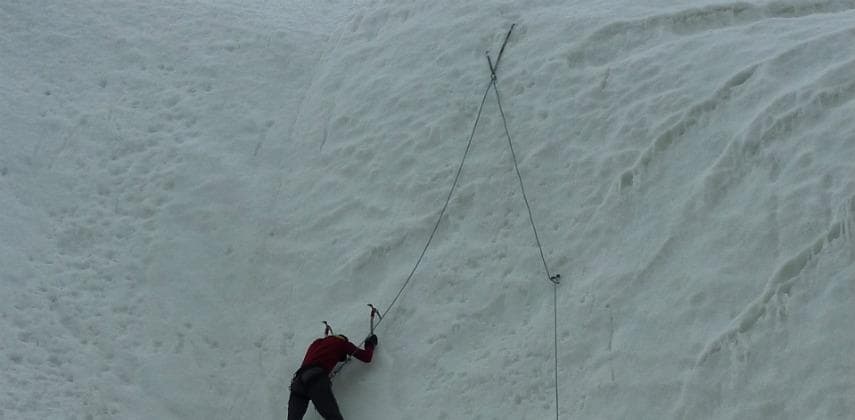
Taking a pair of ice axes, jumping across a wide crevice and impinging the picks into the ice cliff wall only happen in movie. Life is precious, don’t try that.