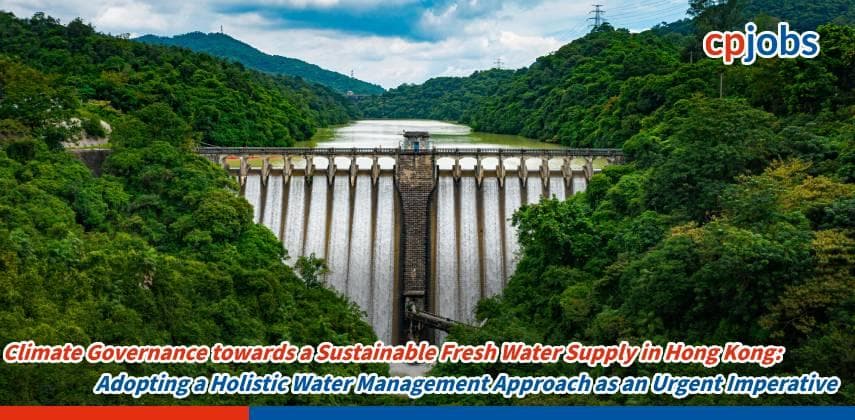
Fresh water crisis is becoming increasingly serious around the world and may obviously impede the sustainable development in many regions across Asia , including the Hong Kong Special Administrative Region. Therefore, it is essential to promote the diversification of water resources and build a resilient water system to respond to climate change.
In Hong Kong, the invisible lack of water scarcity creates an illusion of plenty control over water supply and consumption. In reality, the drastic climate change impact observed in the Pearl River Delta (PRD) in China has induced a major uncertainty on long-term water availability. Recent research revealed that river flows in the PRD could decline by 24% by the 2070s. The Dongjiang basin, the source of approximately 80% of Hong Kong’s water , is already recognised an area facing water scarcity, with pressing water demand from nearby cities. As such, water allocation to Hong Kong as per the terms outlined in the Dongjiang water supply agreement could be challenging in the near future.
In terms of water supply efficiency and cost-effectiveness, water prices in Hong Kong are less than one seventh of the actual water production cost. This is problematic to fiscal sustainability as the revenue-expenditure gap of the Hong Kong Water Supplies Department (WSD) was HK$46 billion over the last decade. In addition, around one third of Hong Kong’s freshwater volume is lost through leaks in mains, private pipes and theft, with recent estimates valuing these losses at HK$1.38 billion. Such losses impact the efficiency and cost-effectiveness of the utility and impinge on its ability to achieve carbon neutrality in terms of capital investments and operational activities in the future.
Although WSD has scaled up its water conservation campaigns and measures in recent years, take-up of these measures among the public remains low. Based on a recent survey, only 32% of households indicated using water saving devices or products from the voluntary Water Efficiency Labelling Scheme (WELS) and only 42% of households had heard about WELS. This suggests that educational campaigns and voluntary measures may not be sufficient to change the water-use habits of Hong Kong residents. As long as the city’s non-water scarce context and price-signalling do not necessitate people to change their water-use behaviours, per capita water consumption is likely to grow unabated, and Hong Kong’s water woes are going to be glaringly apparent sooner rather than later. Over the past four decades, Hong Kong has moved towards increasingly unsustainable consumption patterns, while maintaining a sheltered exterior of a plentiful water supply. Obviously, current measures targeting water supply and demand are not enough.
Furthermore, Hong Kong is confronting practical challenges when it comes to its existing programmes and is lagging in developing alternative sources of water supply. Hong Kong has been using seawater for toilet flushing over years; however, this has contributed to higher maintenance requirements due to pipe corrosion caused by high-salt content. Also, the implementation of rainwater harvesting and grey water recycling systems have been formulated and incorporated into the water conservation strategy, but was restricted to government buildings only so far. With respect to water supply source diversification via seawater desalination, the construction of a desalination plant at Tseung Kwan O is expected to provide valuable contribution. Nonetheless, concerted actions of researchers and key stakeholders of seawater desalination operations, under a sustainability framework, are necessary to come up with adequate measures to durably avoid possible impact on marine biodiversity and ecosystems. Similarly, the reclaimed water programme in place in the city can compete with freshwater supply alternatives for a range of non-potable uses in non-domestic sectors. However, further feasibility studies are necessary to ensure the practicability and economic viability of wide-scale implementation in Hong Kong. Sourcing fresh water using less energy-intensive methods and with less impact on the environment, in conjunction with adherence to strict water conservation measures, might be preferable for both economic and environmental reasons in most situations.
On the other hand, the latest Annual Report of WSD estimated that carbon emission from freshwater treatment were about 452 million kg-CO2 in 2022, with a 30% increment compared to 2021. In this regard, a false sense of water security is breeding unsustainable habits in Hong Kong. In comparison with the remarkable progress made by Singapore in developing alternative water sources and its continuous drive to leverage smart technologies to strengthen operations and meet future needs; it is clear that Hong Kong is lagging behind. It is thereby essential to review the water supply resilience strategy for the sake of Hong Kong’s future. Adopting a holistic water governance approach, that fully integrates climate risk, energy, water conservation, emission abatement, enhanced transboundary research cooperation, innovation, and creative solutions for overcoming institutional and political obstacles, appears to be an urgent imperative.
The proposed approach should set up a resilience and sustainability analysis framework that measures the socio-economic pressure, policy responses and development progress of Hong Kong and its regional neighbor in their capacity to adapt to water supply challenges. Thoroughly scrutinising the multifarious local conditions in Hong Kong will undoubtedly enrich the framework and help build sustainability strategies that fit the complexities of engineering, economic, and political issues effectively.
Concretely, reforms in water governance in Hong Kong, in concerted action with key regional stakeholders, should consist of (i) establishing a comprehensive water policy, strategy and targets; (ii) improving the management system by identifying social goals to inform a sustainable water strategy; (iii) plugging the gaps in the water supply system; (iv) diversifying water supply sources through research on efficient management of aquatic environment; (v) proactively adopting smart systems and innovation to achieve carbon neutrality, cost-effectiveness; while promoting water conservation devices; and enhancing both demand and supply-side management efficiency; and (iv) embarking on a comprehensive stakeholder engagement process to raise consumer’ awareness on water conservation and sustainability concerns.
Water supply challenges in Hong Kong are significant and will not disappear if ignored. By taking prompt actions, Hong Kong can significantly enhance its ability to address these issues, build resilience, and thereby create a more sustainable future for the next generations.
By Ir Dr Alex GBAGUIDI
Committee Member, The Hong Kong Institution of Engineers – Environmental Division